Ask ten runners how many carbs they take during a marathon and you'll get ten answers. A gel at mile 6, maybe another at 13, and something sugary from an aid station if the stomach allows. That is what most of us did for years.
Then the pros started taking in numbers that would have sounded ridiculous a decade ago. And now the research is catching up.
Here is what the newest studies say, where the real limit sits (hint: it's your gut, not your muscles), and how to find your own number without wrecking your race or your week.
Why carbs matter on race day
Your body stores only so much glycogen. For most of us, that tank runs low somewhere in the back half of a marathon, which is where the wall lives. Taking carbs in during the race gives your muscles fuel that doesn't have to come from the tank.
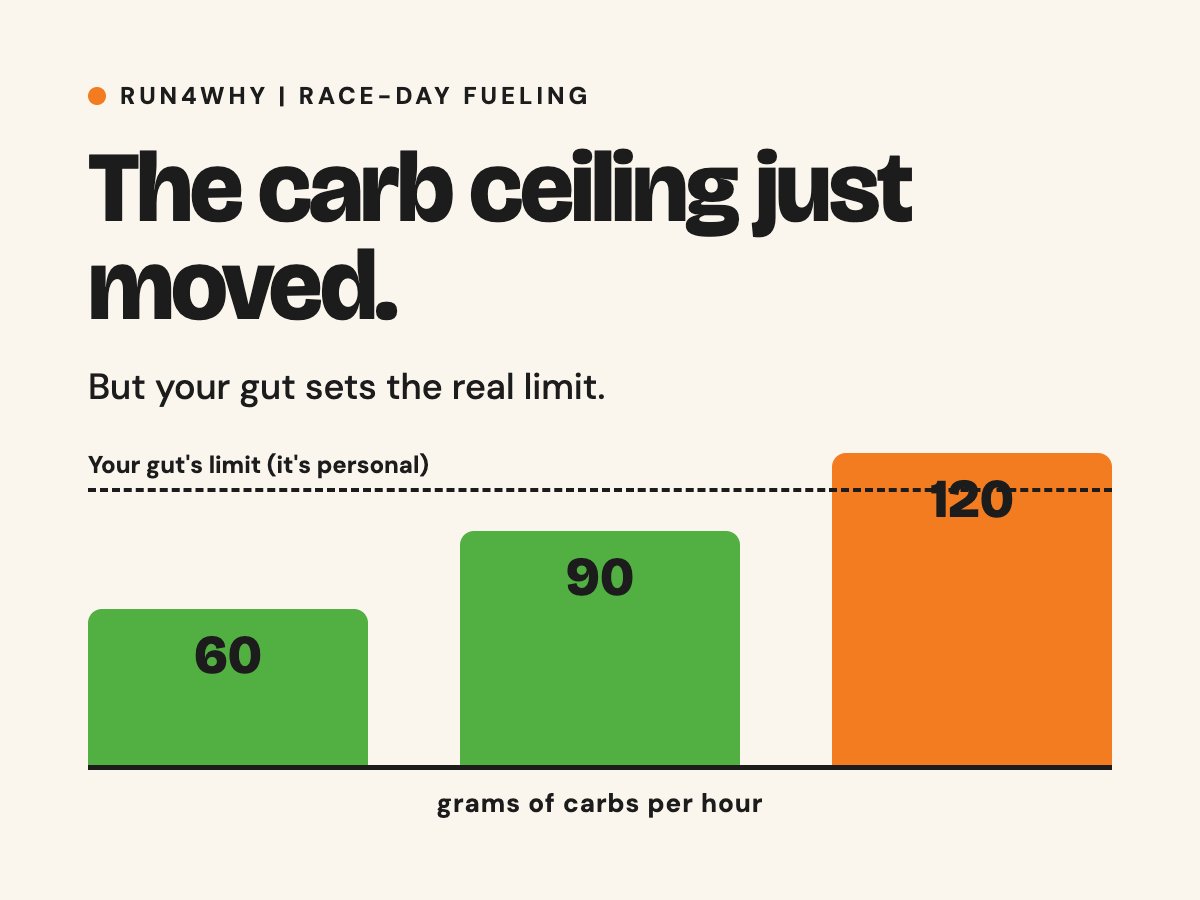
For years the guideline was simple. Somewhere around 30 to 60 grams per hour for most runners, and up to 90 grams per hour for long events if you use a mix of sugars. The reason for that cap was biology. A single type of carbohydrate, like glucose, maxes out at roughly 60 grams per hour of what your body can actually burn. Add fructose and you open a second pathway, which lifted the ceiling to around 90 to 105 grams per hour in the lab (see the review Carbohydrate feeding during exercise, linked below).
That was the state of things. Then the studies got bolder.
What the newer research shows
The 2025 Ravikanti study (Journal of Applied Physiology). Researchers had eight elite male marathoners, with personal bests around 2:23, run two hours on a treadmill while taking 60, 90, or 120 grams of carbohydrate per hour. At 120 grams per hour, the runners burned more of the carbs they ingested, and their running economy improved compared with 60 grams per hour. The gap between 120 and 90 was less clear cut, and stomach symptoms were highest at 120.
The mountain marathon studies (Urdampilleta and colleagues, Nutrients, 2020). Elite trail runners who had done gut training took in 60, 90, or 120 grams per hour during a mountain marathon with about 4,000 meters of climbing. The 120 group reported lower internal load and showed lower markers of muscle damage 24 hours later. They also recovered their high-intensity running capacity better.
The big-picture review. A 2025 review in Sports Medicine by Wilson concluded that the existing research doesn't directly show a performance benefit at 100 grams per hour or more versus 60 to 90. In other words, the upper end has risen, but nobody has proven that more is always better for race times.
So do you have too much? On the fuel side, we haven't found a hard ceiling yet. Some elite athletes now fuel at 120 and above, usually after a lot of gut training. The limit that keeps showing up is much less glamorous.
The real limit is your gut
Everything you swallow has to leave your stomach, cross your intestines, and get into your blood before your muscles can use it. When you push carbs faster than your gut can handle, a few things happen. Fluid and sugar sit in the stomach. Blood gets diverted to working muscles and away from digestion. You get nausea, bloating, cramps, and sometimes a mad dash for a porta-potty. In the worst case, digestion basically shuts down and you can't take in anything at all.
A few things worth knowing from the literature:
- Stomach symptoms tend to be worse during running than cycling, and often show up more in longer efforts. Much of the high-carb research comes from cycling, and a lot of it from male athletes, so be careful copying those numbers straight to your marathon.
- Individual variation is huge. One study of highly trained runners tested a short high-carb diet plus gut training (Short-Term Very High Carbohydrate Diet and Gut-Training Have Minor Effects on Gastrointestinal Status and Performance in Highly Trained Endurance Athletes, linked below). Responses varied a lot from person to person, and the average effect was small.
- Effort matters. The gut that handles 100 grams an hour on a comfortable pace can get much fussier at race intensity.
The takeaway is a balance. More carbs can help, but only the carbs you can actually digest and absorb. A big number on your fueling plan that leaves you doubled over at mile 18 is worth less than a smaller number you can take in all the way to the finish.
How to find your number
This is where I want you to think like a coach, not a lab.
1. Start where you are. Track what you actually take in on your long runs for a couple of weeks. Most amateur runners land somewhere between 25 and 60 grams per hour. Many gels are around 20 to 25 grams each, so read the label.
2. Raise it slowly. This is the 10% rule, applied to your stomach. Add 5 to 10 grams per hour at a time, and only after your gut handles the current amount without complaint. Don't jump from one gel per hour to three on race morning.
3. Practice on easy days. This is where the 80/20 rule earns its keep. Most of your runs should feel almost too easy, and those conversational long runs are the perfect place to rehearse fueling. Your legs aren't stressed, so you can pay attention to your stomach. Practice at race pace in a few key workouts too, since that's where the gut gets pickier.
4. Mix your sources. Above about 60 grams per hour, the research points to blends of glucose and fructose so you use two absorption pathways. Many sports drinks and gels are already built this way.
5. Watch the concentration. Very thick, concentrated drinks and gels can slow things down. Take gels with water, and sip fluid steadily rather than in giant gulps.
6. Keep it real where you can. My nutrition leans toward minimally processed food, the way our ancestors ate day to day. On race day, though, it's fine to treat fuel as a tool. If you like real-food options, things like dates, honey, maple syrup, or ripe bananas can work well for some runners in training. Test everything.
7. Write it down. Note what you ate, when, how the stomach felt, and how the last miles went. Patterns show up fast.
What this means for you
If you're a true beginner, don't worry about 120 grams per hour. Your job right now is finishing comfortably. A modest, steady fueling plan you've practiced beats anything you read in a study about elite runners.
If you're a returning runner, check whether your old fueling habits still work. The science has moved, and so has your body. Retest before race day.
If you're a PR chaser, the higher numbers are worth exploring, carefully. Build up over a full training block, practice at race effort, and be ready to dial back if your gut says no. Minutes lost from a slightly conservative fueling plan are nothing compared to a race lost to a shut-down stomach.
Back to your why
I say this to every runner I coach. Before we talk pace, gear, or grams per hour, you need a reason to be out there. Your why is what gets you to the start line, and it's what carries you through mile 22 when everything hurts. Fueling is just one way of taking care of the person doing the running.
Get curious, experiment one small change at a time, and trust the process over a headline number.
Want a plan built around you? Sign up at app.run4why.com (that's app.run, the number 4, why.com) for a free customized training plan and unlimited chat with my AI agent. Complete the 7-step onboarding, and I'll review and approve your plan personally.
And I'd love to hear from you. What are you taking in on long runs right now, and what has your stomach taught you? Drop it in the comments.
Sources
- Ravikanti S, et al. "13C-labelled glucose-fructose show greater exogenous and whole-body carbohydrate oxidation and lower O2 cost of running at 120 versus 60 and 90 g/h in elite male marathoners." Journal of Applied Physiology, 2025. Read the study
- Urdampilleta A, et al. "Effects of 120 vs. 60 and 90 g/h Carbohydrate Intake during a Trail Marathon on Neuromuscular Function and High Intensity Run Capacity Recovery." Nutrients, 2020. Read the study
- Wilson (2025), Sports Medicine, review of carbohydrate intake at 100+ g/h versus 60 to 90 g/h, as summarized in The Modern Carbohydrate Playbook (IAMCOACH)
- "Carbohydrate feeding during exercise." European Journal of Sport Science. Read the review
- "Short-Term Very High Carbohydrate Diet and Gut-Training Have Minor Effects on Gastrointestinal Status and Performance in Highly Trained Endurance Athletes." Read the study
- Overview of the 2025 marathon study and practical takeaways: Born on the Trail